Thursday, April 21, 2016

Tiring Termites Give Up Rather Than Slow Down: Insights to Metabolism Through Rate of Travel

Paul Fischer
3/3/2016
Ravi Nagori, John Mitchell


Tiring Termites Give Up Rather Than Slow Down: Insights to Metabolism Through Rate of Travel


Introduction
Discussion has been given to the nature with which termites travel using bridges and pheromones as factors in rate and distance of travel. Limited laboratory equipment and resources as well as an exhaustive number of experiments will require significant effort to eliminate redundancy or inaccuracy in the trial which will be provided. After preliminary observations which identified some key characteristics in the nature and travel of the termites, a novel approach to determining existential factors in the metabolism of the insects has been concluded.
Some mention of metabolism is provided in the research from Loreto et al. (2013) but statistical analysis was not able to ensure a consistent nature to the basic rate of travel of termites, and in one trial results were quite unexpected. This offers some basis for return to laboratory experiments and investigation of possible sources of the inconsistent results. The experiment will evaluate the rate of travel at two points in a track by insects after eliminating outlying results, which will hypothetically establish the presence of a “tiring” mechanism, or a metabolism factor in the termites. This will be shown with a significant deviation (p<.05) between mid-trial termite times and terminal termite trial times. Rejection of the hypothesis will indicate that termites travel at a consistent pace throughout the course of the trial.

Methods
Observations were completed using termites in wet, infested logs. Collection by hand was performed and included addition of wet napkins to clear plastic plates which housed the termites in between trials. The track was constituted of kimwipes and included ink-penned marks along pheromone-laced trails which the termites followed; this was replaced with every trial of multiple termites. Termites that refused to follow the track or did not conclude the track were removed in a short period and their results were counted as incomplete and the rates of completion will be shown in Table 2.
A stopwatch or clock was used to observe the time for a fresh randomly assigned termite to complete each track, repeated 15-20 times, and basic calculations performed to obtain the rate of travel at multiple points 3”, 6”, and 8”, which will be provided in Figure 1 and Table 1 as well as statistical significance across results to eliminate the possibility of wide variance in the research. Times were collected at each of the three points in one trial and then repeated in three more trials with each individual distance. Termites were collected after individually completing their trials and transferred through a waiting cell with a wet kimwipe back into their natural habitat, the woody environment. This provides the first set of data necessary to confirm the hypothesis: termite mid-trial rates of travel. Standard temperature and pressure was expected as well as atmospheric qualities, and the track was encapsulated by clear plastic to help ensure this. The experiment was repeated using only 3”, 6” and 8” tracks, this time with 15 trials, to help ensure data accuracy, and to confirm the hypothesis.

Results
No instance of significant deviation was observed after statistical analysis using a p-value limit p<.05 to determine significance across multiple sets, except in comparison of different length tracks, which can be seen in Table 1 and Figure 1 below, though variance was likely too great to determine statistical significance in comparison of closer distanced tracks. Completion rates degraded as expected across the various length tracks of the termites, seen in Table 2. This establishes the premises upon which the hypothesis can be tested, as the termites were behaving in a logical fashion, and not attempting these tracks in a random sense, so statistical analysis across data sets can now be warranted.
Results were analyzed by comparing across two data sets of the same length, one three inch track mid-trial, and the other only 3 inches in sum. Comparison of 3-inch tracks with 3-inch mid-trial times results yielded a p-value of .447, indicating a statistically non-significant difference between rate of travel for termites mid-trial in comparison to a short trial, which rejects the hypothesis. Original inclusion of 2-inch tracks, raw data for which can be derived from the supplemental materials, into the Figure 1 below, did not demonstrate a significant difference in rate of travel for the late trial period, but did confirm significant difference in raw times compared to other lengths of travel, excluding 3-inch mid-trial results which is done because the p-value of .227 is likely due to variance, not in inherently significant changes in rate of travel that would result in an insignificant difference between overall times over different lengths.


Table 1: P-values between data sets obtained

P-Value
3-inch mid-trial and 3-inch from start
.447
3-inch trials from start
.113
6-inch trials from start
.432
8-inch trials
.372
3-inch trials to 6-inch trials*
.0016
3-inch trials to 8-inch trials*
.0049
6-inch trials to 8-inch trials*
.044
2-inch mid-trial to 3-inch mid-trial
.227
2-inch mid-trial to 6-inch trials*
5 x 10^-5
2-inch mid-trial to 8-inch trials*
9 x 10^-6
*Denotes statistically significant difference


Table 2: Percent completion for each dataset
Datasets
3-inch mid-trial
3-inch trials from start
6-inch trials
8-inch trials
2-inch mid-trial
% Complete
35%
45-7%
35-40%
25-30%
30%


Figure 1: Average Times and Standard Deviations of Termites*
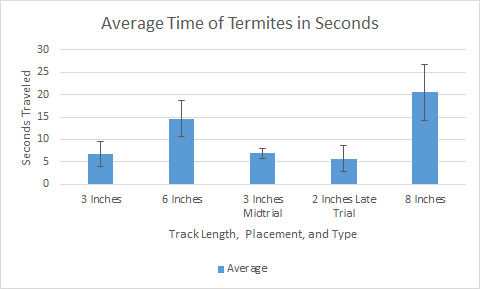
*No instances of statistical significance in comparison to mid-trial rates of travel.

Conclusion and Discussion
The greatest observations of note in this experiment are the degrading rates of completion by the termites with increasing distances, seen in Table 2, and the unwavering rate of travel in those that complete their tracks. This indicates that termites do give up traveling along pheromone laced lines when tired or distracted, but will not slow down. It is important to remove the outliers because it became apparent after preliminary observations that some termites do not have the capability of completing a track or identifying the pheromone trail which will determine their direction of travel. Some assumptions will remain in this trial, such as the amount of pheromone used, but the removal of outliers should have established a steady point to observe the individual insects, which presents in the statistical significance seen in Table 1 between distances traveled by the termites.
A significant difference between rates of travel from the start and rates of travel recorded in the middle of a trial would confirm the hypothesis that termites either tire or warm-up to complete a track, and change their rate of travel mid-trial. Failure to find a statistically significant difference between the rate of travel along three inch tracks when beginning a trial and mid-trial, seen in Figure 1, shows definitively the hardy behavior of the termites even with traveling periods of significant distances. That is a conclusion which is backed by the expression of a significant difference between trials of different lengths, necessary to show that there is not simply a wide variation in all termite travel which would indicate a necessity for retrial with a greater sample pool, or more precise laboratory equipment. For the purposes of this research, this experiment can be said to have to have rejected the hypothesis presented.
Indications of the nature of the termite behavior can be interpreted accordingly, and with cross-reference on dietary habits some insight can be drawn. Original interpretation demonstrated these percentages and differences as indicative of the termites’ stage in life, further investigation revealed this to be a function of the type of termite being used. This was confirmed in further reading among the metabolic nature of termites including an experiment from 1925 which demonstrates the consistent nature of the creatures even under such miserable conditions as acid and ash (Cleveland, 291-2).
The variation in completion of tracks proceeds logically, though is not subject to a statistical analysis, and termites were less likely to complete longer tracks than shorter tracks, as shown in Table 2, ranging from 47% at 3 inches to as low as 25% by 8 inches. Mid-trial results and 6 inch trials fall in between these results appropriately and consistently. These are the only indication of a tiring mechanism supported by data in this experiment, which warrants further investigation and is discussed to some extent with ants (Loreto, et al.) which follow bridges and perhaps scents based on absorption patterns but could be more difficult to evaluate in terms of termite behaviors.
One experiment coming to mind would be utilization of a plastic surface instead of a paper surface and perhaps a fabric one as well in order to firmly establish the impact of pheromone quantity on the results, a possible source of error discussed previously. It is worth mentioning that repetition with a greater data pool would likely establish statistical significance between 2 and 3-inch tracks, but would be unlikely to yield any change to analysis of mid-trial data, based on comparison of longer time difference analysis. This discrepancy is worth further investigation before warranting any full repetition of the data set. Another extension of this work would be to draw on the work of L. R. Cleveland and evaluate whether the longevity of termites is reflected in consistency of their rate of travel, though adequate conclusions may be possible simply from evaluation of the raw data provided here and in subsequent work to that study on the topic of termite longevity.


References:
Cleveland, L. R. (1925) The ability of termites to live perhaps indefinitely on a diet of pure cellulose. Biological Bulletin 48, 289–293.
Loreto, R. G., Hart, A. G., Pereira, T. M., Freitas, M. L., Hughes, D. P., & Elliot, S. L. (2013). Foraging ants trade off further for faster: use of natural bridges and trunk trail permanency in carpenter ants. Naturwissenschaften, 100(10), 957-963.
Supplemental Data (in seconds):
Experiment 1: 3", 6", 8"
Column1
Column2
Column3
Column4
trial
Start to A
A to B
B to C
A to C
1
2
5
3
10
2
9
7
5
22
3


4


5


6
6
6
4

7


8


9


10
7


11
10
7
11
28
12


13
4
8
7
19
14
9
7
4
20
15
7


16


17


18
13
8


19


20


Experiment 2:
3”
Experiment 3: 8"
Experiment 4: 6"
trial


1
6

18
2

14

3


4


5
7


6


7
8


8


9
7

15
10

29

11


8
12
5

19
13
4
20

14

27
15
15
4
16
14

Thursday, February 25, 2016

Technical Innovation and Responses to Deforestation in the United States, 1904-6

Paul Andreas Fischer
2/16/2016
Professor McCollough


Technical Innovation and Responses to Deforestation in the United States of America, 1904-6

The importance of two technical innovations will be described as component to the development of American communities can be seen in the development of early modern forestry, analyzed in this first of a two part series spanning the time period from 1904 to 1934. The United States prevented the expanding economy at the beginning of this span from turning the landscape into a barren wasteland such as had been seen historically through technical innovation which also made this development possible. This will be seen in the span of production of on a qualitative level, an analysis with profound implications for the economic horizons at the time.
Some segmentation and disambiguation will be necessary as attention will be offered to technical innovation in forestry and to reforestation efforts, providing a cycle from the origins of deforestation and reforestation in the glimmer of the mirror of a prospector’s hypsometer through the measuring and production process with the hypsometer and back to the seed trees which allow reforestation. The seeds of the conservation movement can be found here, and this will be touched upon in summation, but will await further investigation in the subsequent paper on the topic. Research covered but not included in this synopsis of certain importance will include the prevention of forest fires and pathogens, which at the time also played roles in reforestation as well as deforestation efforts.


Addressing Problems in Forestry and Assembling Individualized Response Systems


Among the earliest efforts to organize forestry efforts in the United States was the establishment of a bureau for efforts in forestry that predated other federal efforts in related fields. Review of literature from Forestry Quarterly in February, 1904 provides a succinct description of the organization of the bureau, authorized and explored in 1903, which proceeds as follows:


Organization of the Bureau:
Forest Measurements and Forest Management - 24.4%
Dendrology (Forest Investigation) - 9.5%
Forest Extension - 14.4%
Forest Products - 14.4%
Records - 30-7%


This bureau was necessitated by a failure of state and local enforcement such as fire departments, not yet fully formed, as well as police responsibilities which were not established as the primary method of prevention (Forestry Quarterly Volume 2, 77-85). Indeed, constitutional protection of endangered forest fire zones at the time only applied to disaster areas after incidence, and were frequently inadequate in nature. This failure was described fully in a report of the Superintendent of Forests to the New York State Forest, Fish and Games Commission after forest fires consumed 12% of state lands, costing over 75,000 days of labor in clean-up costs.
State responses to forest fires and other dangers were not limited to New York, however, and two case studies are offered which endeavor to measure the results on states both farther east and west. In Massachusetts for the first time the unique nature of forests in relation to property is being addressed at this time. Simply prosecuting and investigating the fires and inadequate control of the land as matters of property destruction were proving futile, and the necessity to involve other departments, or establish such divisions as necessary had become apparent (Forestry Quarterly Volume 2, 59). One unique approach was the expansion of insurance companies’ corporate presence in the field, other suggestions include tax reform, though ultimately the report acknowledged that at the time Massachusetts had premier standards for forest care, which it was not wont to dismiss (74). The impact of neglect turning profitable woodlands into barren wasteland is well summarized, as, “neglect breeds neglect, carelessness induces indifferences; thriftlessness is our neighbor may sometimes stimulate by bad example to increase activity and thrift on our part, but when a whole community is slovenly, the character of the best is endangered by contagion” (54). The concern to intruding pathogens is addressed at this time, a field pioneered at the time, as fungal infection would be a primary concern for foresters in the coming decades. With the power of the newly innovated microscope this was a challenge that could be finally tackled, though this is a development which will be cited in the subsequent installment to this series.
In Michigan, concerns over the flames arising over groves of young pines gave rise to prevention of forest fires, and was a relatively new concept and will come into play as intrinsically tied to reforestation efforts. This will be discussed in nature with the results from a Minnesota experiment that was released subsequently, also in relation to pine trees, and would prove a critical seed source for early reforestation efforts. Firstly, however, it would be advantageous to take a look at some of the technological innovations making this expansion of the academics and industry behind forestry possible.
Hypsometer: A Glimmer in the Forester’s Eye Removes Trial and Error From an Industry, and Enforces the Scientific Method


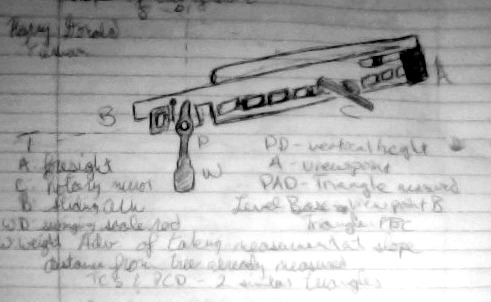
The hypsometer was a device used to measure the height of trees, and a new design by Henry Donald Tieman described in May 1904 increased the efficacy of the device by double over the former model known as a Faustman, to around 45 trees an hour (Forestry Quarterly Volume 2, 144-7). The layout for the device can be seen below in figure 1 and a short description of its methodology will be provided. An example of how this device increases efficacy is the way it removed the necessity to calculate the slope of the ground into an equation to find the height of the tree, an extraneous piece of work, by virtue of a hanging weight. This 9.6 ounce device would transform the nation’s understanding and utilization of the scope of extant natural forest resources.
Photo on 2-18-16 at 1.48 AM.jpg
Figure 1. Hypsometer
A: Foresight, viewpoint B: Sliding Arm C: Rotary Mirror PD: Vertical height
PAD, PBC: Triangle measured TCS & PCD: 2 similar triangles W: Weight WD: Swinging Scale Rod
The impact of this invention on forestry in America can be imagined in two ways. Firstly, the process of tree prospecting was transformed. Vast areas of woodland were suddenly able to be quantified and prepared in value before lumbering operations were even deployed, this would feed the maturing railroad industry into its final stages of transportation dominance. More importantly, one only needed a basic set of calculations, generally prepared, in order to use this, transforming the investment and education needed to perform the otherwise costly process of prospecting for timber. That was a device which certainly increased the supply of timber, one that was met with an unflinching demand as industrial and corporate interests continued to boom. A tandem nature to the innovation creating a positive influence in the process of reforestation would be shared with another device that would prepare a log for use with unprecedented efficiency.


A New Xylometer Increases Production But Reduces Waste In the Lumber Industry


A similar paradox in engineering for the early conservationists of the time was found in the development of the xylometer. Profitability of the lumber manufacturing process was increased and greater supply of railroad ties allowed while waste in the production process was reduced, introducing an economic shift similar to a declining demand, as a result of the technical progress. The new design is pictured in figure 2 and can be found originally in the November, 1905 issue of Forest Quarterly, increased the number of ties, or pieces of lumber, that could be effectively quantified to twenty per hour (Forest Quarterly Volume 3, 335-8). The new technology developed in explicit co-operation with railroad corporate interests was of greater centrality to understanding the true benefit of the advance and yielded an indisputable increase in efficiency.
In order to evaluate this latter advantage, it will be first critical to examine some of the technical details behind previous attempts at the considerably important task of weighing and volumetrically categorizing lumber (Forestry Quarterly, 335). The most successful and widespread was the use of a water tank in order to weigh lumber, using a gauge to measure the displaced water and there-by find an estimate, though inaccurate, of the amount of lumber provided. Efforts to industrialize the process of timber harvest presented a problem with the former method, however, similar to the investigation at the time in the halls of academia with invasive fungi and insect species rotting standing groves of white pines, but instead induced rot in logs already prepared for production. Rather than rotting on the hills as they lived, this occurred as a result of the minutes it would take to load and unload a series of logs from a water tank in an efficient manner. Entire forests would then be wasted.
The new device relied on railroad technology for use and could weigh an individual log. Both of these removed much of the necessity for manual labor and increased precision of smaller operations (Forestry Quarterly Volume 3, 336-7). In addition to saving labor, the winch also provided a diameter of the log and allowed calculation of the specific gravity of the wood being prepared for the production process, generally in housing or transportation concerns. An interesting sidenote is the raw mathematical power making the progress possible, Humphrey’s or the Vermont Rule and Constantine’s Rule, gave individual loggers and companies the capability of making scientific work out of what would have been previously a rude game of guessing or estimation. Once again, the process would have required an educated individual and a significant amount of waste but was successfully replaced by someone who only had a general literacy, or capability of applying a chart to their manual labor (338).
Xylometer.png
Figure 2. Xylometer


Conclusion: How American Innovations Built the Land and, Ironically Enough, Saved the Landscape


The time period addressed in the periodical review from Forestry Quarterly demonstrated a period of significant research into forestry in the United States. Industrial expansion was massive, and these clutch bits of innovation and their mass-production allowed it to continue. This research would also prove necessary to allow the continuation of the American landscape, and establish conservationism as an environmental movement which remains enshrined by federal statutes, organizations, and cultural behaviors today.
Some of the aspects of forestry described work together, such as with the dual-utility of the hypsometer in deforestation as well as reforestation, and it will subsequently be necessary to evaluate what political and economic changes were made. This will be accomplished through a localized approach. In Vermont these technical innovations will be seen to radically change the nature of America’s relationship to the land. The techniques and inventions developed and described above provided stimulus behind the 1920s, and achieved maturation along with a fresh generation of timber, a president from the Green Mountain State, Calvin Coolidge, would be elected president and the legal structures of the renewed vision of American forests as more than resources but as crops will be seen in action. With the Great Depression looming, it may also be possible to make some conclusions about how the enormous growth of these efforts, which can now be confirmed to have occurred in Vermont, may not have spread to other states quickly enough to prevent what was definitively the greatest economic crisis in American history, though this will not be the purpose of further work in this field.


References:
Fernow, B. E, New York State College of Forestry, and Ingentaconnect. Forestry Quarterly, 1902.

New York State College of Forestry. Forestry Quarterly, 1905.

Thursday, February 4, 2016

The Red Terror Arises From the Ashes of the Green and White Armies: Revolution, Civil War, and the Cheka

Paul Andreas Fischer
2/1/2016
Professor Youngblood

The Red Terror Arises From the Ashes of the Green and White Armies: Revolution, Civil War, and the Cheka

As the rising dust of the peasant revolts superseded the omnipresent factory smoke both literally and figuratively as WWI faded into the Civil War, an early and thoroughly Marxist interpretation of the party’s agenda gave way to more pragmatic concerns. The early Bolsheviks’ program moved to adopt the peasantry into their program and address their concerns while consolidating power over state and electoral procedures. This was a development which established an interesting dichotomy in the structure of the Bolshevik party, avoiding co-operation with opposing Socialist forces within Russia and saved the Party from factions within Russia that wished a complete privatization of land and reversion to older practices. Both will be examined as distinct components of the socialist political machine in Russia during the Revolution and subsequent social and economic deprivation along with significant military atrocities.
The roots of Bolshevism rejected the presence of the peasantry in a post-revolutionary society entirely, as a position which operates outside of the normal range of functionality for a successful Communist state under conventional Marxist theory (Barker and Grant, 305-10). This is evident in early essays of Iosef Lenin as well as in his work which encourages the people of Russia to look towards the movement of the previous attempts at Revolution which he admits in his “April Theses” of April 1917 had placed power into the hands of the bourgeoisie as the proletariat lacked organization or class consciousness (Weinberg and Bernstein, 40-1). Already the “second stage” is identified as one which places “power in the hands of the proletariat and the poorest strata of peasantry” which hints at later attempts to strike at the kulaks, a financially empowered minority of the peasantry accorded some rights by the imperial regime and Provisional government, but which posed a significant threat to the status quo, and would rebel in five districts (Weinberg and Bernstein, 83).
The status of peasant, however, is so ingrained into Russian culture and society that it was not possible to see a Communism rise in Russia without some critical new curtain of demonstration to the ideals which would be encouraged in the people; premature action by the “man in the street” could spoil the nation’s wealth and demand the impossible (Barker and Grant, 331-5). The significance of the peasant can be seen as self-evident in the cries of a peasant in the opposition of privately owned property in late 1917 (Weinberg and Bernstein, 48). That the very individuals who labor for the land live in poverty is a central theme in the work, and this correlates well the cries of the peasantry in Peasant Resolution in late October of 1917, the week before armed insurrection in Petrograd, which add to this a need for the peasantry to have access to basic necessities in addition to public ownership of the land (Rowley, 122-3).
In order to understand the peasantry in relation to the development of the Bolshevik party, some understanding of the characters in play must also exist. Leon Trotsky followed the fall of the Provisional government and aforementioned armed insurrection at Petrograd with urges to Bolshevik followers to allow their voting be their oath (Weinberg and Bernstein, 53). This was a hint at later despotic and dictatorial methods which would be utilized by the party including the establishment of the secret police, the Cheka. That secret police which expanded rapidly would represent part of the rapidly changing double-standard extant both in the party discussions as well as in opposition, a key development in which is to evaluate the role of the Civil War which would last until 1921.
The avant-garde architecture of Vladimir Tatlin, Model for the Comintern Building, which remains unbuilt, is tenuous in structure at best (Rowley, 128). Revolutionary society mirrored this gut-wrenching design at the time. The Cheka served the purpose of the fish-line in the design, which should only exist in the time of Civil War, and be invisible to the viewer’s eye. Instead they became dark and hideous, and among the most hated parts of the Bolshevik agenda. Discussion of the Cheka would be incomplete without discussion of the Kronstadt rebellion in which hundreds of sailors were executed and thousands imprisoned as dissatisfaction with the new rule was demonstrated in their proclamation “What We Are Fighting For” which bemoans the replacement of the hammer and sickle with the bayonet and barred window (Weinberg and Bernstein, 88-9). It would be best not to forget that criminal reform was a primary focus of the Revolution of 1905, and despite the first World War, remained critical to many members of the population’s satisfaction. Over the course of the organization’s early existence, in these first years of revolution hundreds of thousands were incarcerated and around 10,000 executed, which Lenin emphasized as critical to the struggle against “Counter-Revolution and Sabotage” but betrayed the reality of the Revolution and Civil War for the Working class (Weinberg and Bernstein, 67).
The commonly known White Army and Red Army were not the only positions during the Civil War, which saw many of the fears of Lenin, Trotsky, and other leaders of the Revolution play out to the tune of horrendous atrocities. A series of Menshevik newspapers detail the worst fears of both White and Red Armies which seemed to have no end, from the stealing of cattle to the wanton burning of significantly more than 10,000 tons of grain by villagers in rural areas (Weinberg and Bernstein, 46-7). Bringing the subject of this work to a head were the efforts of the “Green Army” led by A. S. Antonov and designated as terroristic in nature, but espoused some legitimate concerns of the population and felt the impact of Communist despotism directly (Weinberg and Bernstein 84-6). At Tambov these “Toiling Peasants” suffered an unknown number of casualties and punitive burning of several villages. Ironically enough, they directly conflicted in nature with the demands of the Peasant Resolution, perhaps due to the aforementioned famine and need for basic necessities, reaching the point that a report to the American President Hoover described communal consumption of dogs in bologna and sausage (Weinberg and Bernstein, 73), and demanded reinstatement of private property and a demonstrative elimination of Cheka-style justice. In order to understand the execution of 10,000 people and the atrocities of the war, some knowledge of the fears of Revolutionary leaders at the time had to be imparted.

It can be seen that many of these forces interacted with one another, and some basic conclusions must be drawn from the work. The Bolshevik Party developed a dichotomy of practices which included developing stages by which it justified repressive and also dictatorial processes that prevented internal factions from gaining excessive control of the nation. The most punitive of these, inspiring rebellion, have been discussed, and others include disruption of democratic procedures which would have profound effects on attempts to spread Communism across the world in later generations. The Party was also saved from an immediate privatization of land and elimination of the gains made on behalf of the working man by terrorist and anarchist organizations in Russia at the time, in part by the serious punitive nature of the actions.

Issues in Taxation, Working Conditions, and Autocracy: Periodic Revolutions and The Revolution in Late Imperial Russia

Paul Andreas Fischer
1/25/2016
Professor Youngblood


Issues in Taxation, Working Conditions, and Autocracy: Periodic Revolutions and The Revolution in Late Imperial Russia


The revolution of 1905 failed as a direct result of Revolutionary inability to incorporate peasantry into their plans for the future government. The imperial authorities gave little to no service to the work of the proletariat in working conditions, to the peasantry in relief of in the servile nature of their work or unnecessary taxation, or to representation in the Duma which was not equally offered to all members of society and which was characterized by repression of free speech and education. Each of these three problems will be addressed in the documents provided which are drawn from the period.
An example of Revolutionary belligerence be seen in Lenin’s “What Is to Be Done” essay written in 1902 (WB, 21). As Party Theoretician of the Bolshevik faction of Socialist Revolutionaries, the dominating side of Socialist-Democrats commonly known as Mensheviks and Bolsheviks, Lenin made a shrewd decision with this which may have worked by the time of the Revolution of 1917, after Russia was forcibly industrialized, this time by war, and on a broader scale than ever before, but appears to be misplaced nearly a decade after his writing with the Revolution of 1905. In fact, it is mentioned in the letter that “it is much easier for demagogues to side-track the more backwards sections of the masses” and in what would today be a risky statement, at the time this group certainly would have included both women and peasants. The promise for a role in a post-Revolutionary society aside, it can be assured that at this time Lenin foresaw no place for them in the execution of a Revolution itself.
The causes of the workers which were ignored by the government paralleled the cause of the peasants, which were inadequately or not fully addressed in early Bolshevism, just as these causes were avoided by the ruling government. Following the Revolution of 1905 as the Emperor only gave a nod to the actions of Bolsheviks, according to the Vyborg Manifesto, which spelled out demands of peasants through the mouthpiece of liberals and leftist deputies, it would appear that the work of the peasants in demanding private property from noble, government, church and other sources had indeed forced the dismissal of the people’s representatives (WB, 33) in the Duma in 1906. Taxation on social drinking may be a euphemism for various activities which culturally would be seen as the responsibility of an adult, and is only included as a concern in A Resolution for Peasants (Rowley, 93). It is important to notice that the workers are not the peasantry, nor vice-versa in this case, and the work should not be interpreted as gains by the proletariat at the expense of the peasantry. Neither were effectively defended.
The cultural reaction to the lifestyles of the bourgeois may seem in retrospect to be petty or unfounded in the events which were transpiring in imperial Russia. The reality is that the reaction, which is noted by peasants and in the work of artists, who frequently came from a lower background, has been called for as intrusions into the everyday life of the peasant, in a time far before any scientific or popular measures could have justified them. This exasperation can be seen in work of Leo Tolstoy (WB, 14), which shows a hypothetical evening in indulgence as well as the servile nature of the lower classes at the time. The government had banned education, and had instituted unpopular taxes, both of which are addressed in an appeal from the Peasants and Petition from Workers to the Duma shortly before the Emperor’s Fundamental Laws were released (Rowley, 93-4). The directive ignores demands to compensate, and therefore, under the imperial mercantile government, to eliminate overtime work.
Education is addressed in the Instruction From Workers (Rowley, 94), which is a call from the factory workers who formed a smoky ring encapsulated by oppressed peasantry and circumnavigating the decadent nobility, and comprised two of fifteen points, a third should be considered the freedom of speech. The October Manifesto granted the of freedom of speech and equal elections for a body, the Duma, which was responsible for all new laws requested. Their subsequent revocation was the grounds for Revolution. Contemporary analysis finds the freedoms may have been greater than those asked for by Lenin in 1902 which will be addressed later (WB, 29-30).
In these documents education, free speech and social responsibilities can be seen to be a primary concern of Revolutionaries. These are ignored in the Fundamental Laws which were instituted by Emperor Nicholas II in order to scale back promises made in the October Manifesto (WB 29-30). These laws are hard to look at favorably, especially after the Manifesto spells some inveterate hypocrisy in the official order, and no escape or guarantee of taxation or of economic stability is offered.
The divine right commanded in the Fundamental Laws gave autocratic power to the Emperor, not only over the state, but over God as well (Rowley, 96). This was not a simple promise or blown smoke which would win over the masses, but a dedication to divine work and the Russian soil which persisted even in his last, albeit doomed, campaigns in defense of the Empire in 1915 (WB, 35). The greatest betrayal of the Russian people in this declaration, however, was the right to revoke the commission of the Duma, a right that due to the divine right described could never be justly reciprocated.
In a Women’s Petition there is sarcastic reference to the “great day of the opening of the State Duma” (Rowley, 95) before complaint from the lack of a single female representative in the proceedings. The main objective of this document is to obtain representation, though other constituent efforts by females from the time would demand health services. One error, though not problem per say, in the Women’s Petition was an insisting declaration that the women were equally represented economically. That was not the case.
The failure of women to receive any representation in the Duma, or equal representation economically at the time is indicative of a general reciprocity in the Fundamental Laws which is not present. While a veto from the Duma would nullify any law made by the Emperor, as a check and balance to provisions which allow the Emperor to veto laws passed or to implement martial law in any area in order to establish the absolute power claimed in the first chapter of the Fundamental Laws, those laws are guaranteed as untouchable by any popular or noble means whatsoever. With censorship and economic hardship coming in the next decade and voiced in a speech by Alexander Guchkov (WB, 33-4) this faint hint of discord would become clear to every faction by the outbreak of the first World War.
The most effective defense of the Emperor’s actions can be found in the work of Konstantin Pobedonostsev who cites the Emperor that, “equal distribution of ‘freedom’ among all involves the total destruction of equality” (WB, 16). The Prime Minister Petr Stolypin announced efforts to build a sewer system in St. Petersburg in 1911 which had become a “breeding ground for both cholera and plague bacteria” (WB, 18). What went unmentioned in his announcement was that the actions of the government were responsible for this overcrowding and poverty, which can be seen in the depth of famine during November 1905 when a resolution from the Soviet established a state of war between the government and the workers as one hundred thousand were forcibly removed to the streets (WB, 31).
As the peasants demand replacement of members of the Duma, the Fundamental Laws clearly state, “The Chairman of the Council of Ministers, Ministers, and Heads of various departments are responsible to the Sovereign Emperor for State administration” (Rowley, 98) which sealed for the newly educated their great ambitions and desire for position. This would alienate the women whose concerns included healthcare which (Rowley, 95), as noted before, were among the few complaints seriously addressed with meaningful action by the government.
Moving from peasantry to proletariat concerns involves a massive shift in horizontal and vertical analysis, but this was accomplished through examination of a petition from the workers, addressing exploitation as well as freedom of speech or education already seen. Support is offered from a primary document from Leo Tolstoy showing the equal return of demands. The most important problem is the failure of the Fundamental Laws, which are appropriate in style for the age of Absolutism but obsoleted by the Revolution, to address such issues after the promising nature of the Manifesto on State Order and the Emperor’s own struggle. The significant omission by Lenin of the peasants from his early work, even highlighting them as a potential liability for Revolutionary activity was brought to light, which should prelude the nature of the coming Revolution, which will be terminal for the imperial family.

Monday, January 4, 2016

Burlington Vermont - Jennifer Green Interview Notes


Jennifer Green - Sustainability Director in Burlington Vermont
Interview by Darby Minow Smith

Old in sustainability: 11.3 million dollar bond for energy efficiency in the 90’s, working on climate change since 1996
8% of food from within city limits
problems: high poverty rate
transportation
air quality increases and decreases

very low vacancy rate means housing costs are very high
1-2% vs. 12% as a national average

energy consumption has been level since the mid-‘80s
municipal energy department
energy efficiency measurements, surcharge towards energy conservation
easy access to information, public domain as Burlington Electric is owned by the citizens

floodplain, Winooski River through the city floods regularly making it unsuitable for housing
also a historic farming hub
Intervale - several dozen community-supported agriculture endeavors
sold in the city market, a cooperative
A fair portion of what the kids in Burlington Schools eat is locally sourced, creativity is key
Sustainability: Connecting four E’s
Environment
Equity
Education
Economics

First Climate Action plan of its kind in the country under Peter Clavelle
Now ICLEI software helps

Institute for Sustainable Communities, Montpelier
prominent nonprofit in the realm of climate change
new resiliency project in Vermont
ideas are beginning to percolate around this topic

infrastructural and agricultural challenges as a result of climate change

Source: Jennifer Green Interview - Sustainability in Burlington, Vermont

Vicki Bennett Interview notes

Sustainability Director Vicki Bennett - Salt Lake City
Interview by Darby Minow Smith

Mormons, snow, sobriety
progressive politics, despite Utah conservatism
poor air quality from burgeoning suburbs: 200,000 in the city, and a further 1 million in the greater metropolitan area

Salt Lake City as settled by Mormon pioneers, refugees fleeing persecution
necessity for independence
comprehensive, holistic approach to planning the city
personification of sustainability
survival and working the land

Met the Kyoto goals by reducing our municipal operation climate footprint
working with more conservative cities necessitates discussion on air quality and reducing vehicle miles traveled and the benefits of energy efficiency to minimize how much electricity to use
reduce amount of oil and heating fuel and natural gas needed - same outcome in reducing use of carbon-based fuels

GOP presidential candidate to admit global warming is real and human caused: Jon Huntsman as typical of Utah Republicans?
definite outlier, most progressive Republican
Comparing Salt Lake City and New York City in the impact of climate change
70% of water comes from mountains via snowpack
no reservoirs immediately next to the city, less water with climate change
quality of water is concerning 
more beetle-kill in the forests
drier soils and higher chance of wildfires > silt in water
Health issues
diseases and vectors

economic impact of less skiing!

Katherine Gajewski - Philadelphia Sustainability Office Interview Notes

Katherine Gajewski Interview by Darby Minow Smith - Philadelphia going green

limited staff and resources -> long hours
“age isn’t a factor”

Greenworks Philadelphia plan
5-county energy-efficiency program
social group of city employees: “Young-ish City Government Workers

Philly is historical, great bones
modest sized, energy-efficient row homes
extensive public transit system
low car ownership rate
9,200-acre park system
These make for a sustainable city, but 300 years ago

25% of the city is at or below poverty, there is a high level of diversity
work raises questions about opinions about sustainable cities

over 1,000 communities in the US are in non-compliance with the Clean water Act because of old sewer systems that, in heavy rain events, mix outlets of cities’ wastewater into the waterways
billion dollar plans to increase the piping and sewer systems underground so excess water can move through bigger pipes
2 billion in Philadelphia to come into compliance with the Clean Water Act with green infrastructure
variety of methods:
-green roofs
-rain gardens
-streets with porous pavement

tie between climate and departments like water
reframing work in context of climate change: absolutely

In 20 years, half the city is going to be covered in green infrastructure
smart streets
parks and open spaces
green roofs

Only 4 years into sustainability plan, rising population

Source: Katherine Gajewski Interview - Darby Minow Smith