Showing posts with label tobacco. Show all posts

Monday, May 11, 2015

Neurogenesis Suppression in Dentate Gyrus Induced by Moderate to Heavy Nicotine Use Finally Shown to Have Negative Impact on Memory Functions?

There is a stereotype that marijuana smokers have hazy or weak memories as a result of their use. Tobacco smoke, on the other hand, is usually discussed in terms of the positive effect on cognition by virtue of the very mild stimulant effects delivered by nicotine. Over a decade ago, however, researchers in Nice, France showed in rats that administration of nicotine, without smoke, induced a suppression of new neuronal births in the dentate gyrus, the part of the brain that handles about 90% of a person or animal's memories. In the last decade as well, researchers from the Chinese Military, Canada, and Maryland have shown that marijuana actually encourages the birth of neurogenesis in the hippocampus (which is responsible for most remaining memories) by 40%, when a pure THC copycat chemical, named for Hebrew University where the compound was made, is administered to rats. Researchers at Princeton University and the Department of Nutrition in Brazil also showed that there was no effect from THC on the dentate gyrus of rats, even at levels producing "gross behavioural intoxication".
This provides a general understanding of the effect of THC on the brain, which should be reproducible in human or population studies which have been conducted. More recent brain scans have also shown this to be true as conducted with human populations, with negligible changes, positive or negative, found in most parts of the brain, though functional connectivity has also been shown to increase in a significant manner with marijuana use this last year.
Most recently, a study from Spain claimed that while virtually every mode of behavioural measurement was equal between marijuana smokers and control groups, a significant (though still within the realm of normal fluctuation) decrease in memory function was noted. This speaks in the face of research that has been conducted about THC or the marijuana that contains it. Even with patients using 10 times the responsible adult use in the sample, and the average number of marijuana cigarettes, or spliffs, smoked in a lifetime being around 42,000 (with one participant smoking over a massive 256,000 times) among those included in the study, the results do not match with rats who were administered high levels of THC; the results should have been positive and not negative.
There is a difference between the human and rat studies, though which is not addressed. In the Spanish study, noting a decrease in memory function, the research explicitly emphasizes that tobacco users were not omitted from the study, and about 75% of the participants were actively smoking tobacco when the study was conducted.
A little background, for the American marijuana user, is necessary. In Europe, people smoke spliffs generally made with hashish and tobacco. The unfiltered smoke doubles the nicotine intake (in some countries there are lower limits on nicotine levels, but in Spain this probably means quite similar to American cigarettes, as there has not been a strict concentration of absorbed nicotine enforced throughout the European Union yet), and this dominates the marijuana culture there. While more efficient, this also means that it is very difficult to smoke marijuana regularly without crossing the threshold of 5-10 mg of nicotine daily at which point positive effects are eclipsed by neurogenesis suppression, assuming the user is smoking on work breaks or at certain timepoints and not regularly throughout the day (the research indicates that doses of more than 3-5 mg of nicotine in the blood at a time is the crossover point from positive to negative effects).
The research in Nice, France, which originally shows the negative impact of moderate to heavy nicotine use on the dentate gyrus, emphasizes that further research is needed to confirm this neuronal difference actually translates to a cognitive change. Research from Riba et al. should be used in conjunction with other research done in this field to confirm this fact, as has been shown above. It is still worth investigating the impacts of age, obviously at certain ages nicotine has a positive effect, while it can be assumed that while a brain is developing such stunting of neurogenesis must induce extreme cognitive defects. For those concerned about absorbing too much nicotine, in the last 70 years absorbed nicotine in cigarettes has increased almost 3-fold in the USA (though in some parts of Europe the composition of a cigarette is much the same as in the early days of the tobacco industry) as companies and governments attempt to limit tar or air pollution intake (read previous research on cancer mortality and smoking for more), one viable option is to use pipe tobacco instead of cigarette tobacco. While the curing process for pipe tobacco means there is more nicotine per gram in the cigarette or bowl, the wide cut of the leaves lowers absorbed nicotine by around 13 times (or 2-4 times in comparison to low nicotine European cigarettes). Normal use of pipe tobacco is also associated with levels of cancer and smoking-related disease more similar to the general population than to the cigarette smokers.

Works Cited:

Abrous, Djoher Nora, et al. "Nicotine self-administration impairs hippocampal plasticity." The Journal of neuroscience 22.9 (2002): 3656-3662.

Filbey, Francesca M., et al. "Long-term effects of marijuana use on the brain."Proceedings of the National Academy of Sciences 111.47 (2014): 16913-16918.

Jiang, Wen, et al. "Cannabinoids promote embryonic and adult hippocampus neurogenesis and produce anxiolytic-and antidepressant-like effects." Journal of Clinical Investigation 115.11 (2005): 3104.

Kochman, Linda J., et al. "Despite strong behavioral disruption, Δ 9-tetrahydrocannabinol does not affect cell proliferation in the adult mouse dentate gyrus." Brain research 1113.1 (2006): 86-93.

Ling, H. W., and CB Wynn Parry. "The amount of nicotine absorbed in smoking." British journal of pharmacology and chemotherapy 4.3 (1949): 313-314.

Riba, J., et al. "Telling true from false: cannabis users show increased susceptibility to false memories." Molecular psychiatry (2015).

Saturday, March 21, 2015

Nicotine shown to have half the constrictive properties on veins as alcohol, and marijuana actually will make them bigger (with vasorelaxatory properties identified in THC)!


Nicotine and vein constriction:
"Smoking was associated with significant changes in the aortic pressure-diameter relation that denote deterioration of the elastic properties and were maintained during the whole study period: the slope of the pressure-diameter loop became steeper (baseline, 35.43±1.38; minute 1, 45.26±1.65; peak at minute 10, 46.36±1.69 mm Hg/mm; P<.001) and aortic distensibility decreased (baseline, 2.08±0.12; minute 1, 1.60±0.08; nadir at minute 5, 1.54±0.07×10⁻⁶ cm2·dyne−1P<.001). In contrast, no changes in aortic elasticity indexes were observed with sham smoking."
Alcohol and vein constriction:
"Blood ethanol levels achieved at 60, 120, and 180 minutes were 649+-48, 1,285±81, and 2,546+-130jug/ml, respectively. LAD cross-sectional area was reduced significantly from control at the end of each of the three dosing periods (-24± 5%, -40± 3%, and -53±.3%; p<0.004). a-Adrenergic blockade had no effecton LAD cross-sectional area, while nicardipine partially reversed the ethanol-induced vasoconstriction. No significant change in vessel cross-sectional area took place in control dogs."

Marijuana and vein relaxation:
"The present results provide strong evidence that THC is a PPARγ ligand, stimulation of which causes time-dependent vasorelaxation"
This results in a lower blood pressure and better athletic performance.
http://www.sciencedirect.com/science/article/pii/S0006291X05021352

Thursday, March 12, 2015

Fine Particulate Matter in Tobacco and Air Pollution, a Prospective Review of Mortality Rates

    Review of mortality rates among tobacco smokers and non-smokers has been inconclusive. While tobacco use is associated with between 1 and 3 years decline in life expectancy in humans (Ferrucci, et al.) after controlling for exercise (associated with a 10 year change in life expectancy), this does not associate positively with rat studies seen in earlier reviews in which rats smoking over 20 cigarettes a day outlived non-smokers by 5% and human smoking patterns which mostly match this group. Studies have also shown poverty to have a similar detrimental effect on life expectancy, but will not be counted in this study, as the assumption must be made (lacking proper surveys) that exercise and income are positively correlated.
     There are two ways of approaching this quantitatively, and both will be pursued in this review to check for logical fallacy. Firstly, the assumption can be made that due to an unsupported difference in the pulmonary systems of rats and humans, that tobacco smoke has a detrimental effect on the lifespan of humans and investigation of how this occurs must happen. Secondly, it can be assumed that there are other confounding factors such as air pollution and radioactive exposure which account for greater levels of mortality in certain geographical areas, making tobacco data coincidental (which would be supported by female trends in the UK where lung cancer increased significantly as smoking declined by 50%, as shown in a previous article).

Fine Particulate Matter in Tobacco: enough to cause cancer, early mortality, neither or both?
     The average cigarette delivers 1525 (+-193) (μg/m3) of fine particulate matter (or "tar" on some cigarette warnings) over a period of around 300 seconds (Gerber, et al.), and each puff contains 60 ml  or .00006 m3, and there are around 10-20 puffs on a cigarette (sizes vary from 60 mm to 100 mm in commercially sold products, the 60 mm will be used, as the most commonly used). This means that in a cigarette there is .0006-.0012 m3 of smoke exposure, multiplied by the average 1525 (μg/m3) parts fine particulate matter yielding .72 μg of exposure. This multiplied by an average of 18 (+-8, depending on the state/smoker) cigarettes per day, delivering into the lung between 7 and 25 μg fine particulate matter exposure over the course of a day. This is the equivalent of standing in a closed garage with ten cars running for 30 minutes (Invernizzi et al.) to put it in perspective.
      Is this enough to significantly change the risk for lung cancer or mortality, according to modern studies on air pollution, and assuming all other factors constant? Every 10 μg elevation in atmospheric fine particulate matter is associated with a decrease in life expectancy of .6 years which does fall within the realm of possibility of the decline of one to three years associated with tobacco use after adjustment for exercise mentioned earlier, but fails to explain why rats smoking similar amounts of tobacco lived 5% longer. To understand this, further investigation will be necessary into a couple confounding factors which may explain why tobacco smoke has a greater deleterious effect on humans than rats, when physically the pulmonary systems should react in step with each other.


Ferrucci, Luigi, et al. "Smoking, physical activity, and active life expectancy." American Journal of Epidemiology 149.7 (1999): 645-653.

Gerber, Alexander, et al. "Tobacco smoke particles and indoor air quality (ToPIQ-II)–a modified study protocol and first results." Journal of Occupational Medicine and Toxicology 1 (2015): 5.
Invernizzi, Giovanni, et al. "Particulate matter from tobacco versus diesel car exhaust: an educational perspective." Tobacco control 13.3 (2004): 219-221.
Pope III, C. Arden, Majid Ezzati, and Douglas W. Dockery. "Fine-particulate air pollution and life expectancy in the United States." New England Journal of Medicine 360.4 (2009): 376-386.
Zacny, James P., et al. "Human cigarette smoking: effects of puff and inhalation parameters on smoke exposure." Journal of Pharmacology and Experimental Therapeutics 240.2 (1987): 554-564.


Sunday, January 25, 2015

Lung Cancer and Smoking in the UK

Britain has half the man-made and natural radiation combined as the US has just man-made.

Females and males stopped smoking in the same rates, from 41% and 52% to 23% and 25% (respectively).

Lung cancer mortality rates have remained the same (55 to 45 per 100,000), and actually increased for women (17 to 30 per 100,000). 

Saturday, January 24, 2015

Confounding research on Chronic Inhalation Exposure to Mainstream Cigarette Smoke Increases Lung and Nasal Tumor Incidence in Rats - Human consumption of tobacco lowers lung lesions, tumours, and other malignancies

There are a number of procedural errors in this study which will be addressed as follows. Firstly the bias or affiliation of the study, published by Oxford University, is listed as pfizer, a corporation that makes smoking substitution products, and was caught bribing academics (in unlisted affiliations) with the intent of maintaining marijuana prohibition. Furthermore, the study was conducted in New Mexico, a part of the USA with high atmospheric radiation at this time, the non-smoking control received filtered air, while smoking groups were exposed to non-filtered air. The study asserts that in mice testing, supporting data was gathered that cigarettes cause pulmonary damage. 
The mice are divided into a control group, a "low-smoking" and a "high-smoking" group. The low-smoking group was exposed to the equivalent of between 20-30 cigarettes smoked continuously for six hours without stopping. The high-smoking group was exposed to the equivalent of 60-80 cigarettes per day continuously over a period of six hours and should have been disregarded as non-evident of human consumption patterns at any time in history. For the purposes of reality, the low-smokers (which in humans is at levels classified as heavy cigarette use), will be used in this evaluation. In addition, in this study the high smoking rats were starved (food consumption 60% of non-smokers), which also indicates this data is not reliable.
Despite the conclusion and abstract's assertion, the data is actually quite positive for regular smokers. Incidence rates of neoplasia in the nasal cavity was lower for smokers than non-smokers.  The survival rate for smoking rats is higher by a significant amount, from 752 days to 779 days. Lung weight of smoking rats was the same as non-smoking rats (an increase was seen by 60 cigarettes per day). Ciliated cuboidal cell metaplasia (mucus in the lungs, a deformity frequently observed with aging that has not been definitively connected to cancer, except in epidermal cases, and then only correlatively) was noted in a small amount in smoking rats. Squamous metaplasia was not observed in smoking rats, but were noted in the 60 cigarette per day group. Keratinizing squamous cysts were not observed in smoking rats, but were noted rarely at 60 cigarettes per day. There were no consistent trends in lung lesions, with sometimes lowest levels in the group smoking 60 cigarettes per day (eg. hyperplasia), sometimes lower in smoking rats (eg. malignant neoplasia) and other times in non-smoking (eg. benign neoplasia), though it should be noted this occurred in non-significant levels in all rats. There is no increase in nasal neoplasia for smoking rats. 
After all this, the study asserts that cigarettes are the cause of problems, but admits, "The reason this study produced significant increases in lung tumors in rats while previous studies did not cannot be determined with certainty." It is fairly clear that while, previous studies have linked regular human consumption to health benefits, the concept of gassing rats with 60 cigarettes per day had simply not occurred. See previous articles for data on cancer mortality rates in the USA and the probability that tobacco use in humans has numerous health benefits. While there is not data here on radiation exposure necessary to lower white blood cells in a rat, it is safe to assume these fall along similar lines with humans, and exposure to an unmeasured number of mrems of radiation was a significant factor in the development of malignancies in the rats. It is possible that filtered air might make a difference in mucous accumulation in rats as well as humans, though this is not definitively connected with cancer or malignant symptoms.


Mauderly, J. L., Gigliotti, A. P., Barr, E. B., Bechtold, W. E., Belinsky, S. A., Hahn, F. F., Hobbs, C. A., March, T. H., Seilkop, S. K., and Finch, G. L. (2004). Chronic inhalation exposure to mainstream cigarette smoke increases lung and nasal tumor incidence in rats. Toxicol. Sci. 81, 280–292. 

Sunday, January 18, 2015

Increasing cancer mortality rates despite technological advances and drastically lower tobacco use in the USA: 1950-2015, 65 years of cancer theory down the drain?

There is no explanation for why cancer mortality rates have not gone down (and have gone up) despite medical advances as the entire nation has stopped smoking. Investment in screening and treatment can ensure near 100% recovery, yet all budgeting goes to cheaper "prevention" which does not work. Since the US cracked down on tobacco use, with success in white males, the overall cancer mortality rate has increased from 184 per 100,000 in 1950-69 to 209 per 100,000 from 1970-1994. Today that rate holds steady at 203 per 100,000. In white females and in other demographics cancer mortality rates have been steady or changed in negligible amounts, but these demographics have had increasing tobacco use rates. Cancer is a painful and unnatural death that can often involve long battles with the disease and should be combatted with all resources available, in treatment and in prevention. While lung cancer rates have fallen, technological advances have allowed earlier detection of lung cancer, which at stages 0 and 1 is among the least deadly forms of cancer, but at later stages is among the most deadly. Without adjustments for technological advances in medical care, no positive statement can be made in regards to success or negative results from anti-smoking campaigns. Meta-data from overall cancer mortality does show that the resources in the war on cancer have been squandered and had an overall detrimental effect on the national health of the country, and some policy change is necessitated, although it must be noted there is no current biological explanation for the lower cancer rates in countries and places with higher tobacco use, these have been correlative not causal links. Atmospheric nuclear weapons testing does match up with the population data, it was ended by the 1970's with the Limited Test Ban, and in the continental USA in 1962, and there is solid science that shows inhaled radioactive particles cause lung and other cancer for 30-60 years after detonation.


See cancer rates in USA: http://ratecalc.cancer.gov/ratecalc/archivedatlas/pdfs/maps/acc-maps.pdf


It can also be noted that the demographic distribution provided in the atlas is vitally important as the female population increased smoking rates slightly and saw a slight decrease in cancer mortality as well as an increase in life expectancy commensurate with the increases seen before anti-smoking campaigns.


Please note that the modern terminology for measuring radiation exposure is the gray which measures radioactive exposure per kilogram of tissue, as opposed to the rad which was formerly used and is an absolute amount of radioactive exposure. In humans, one gray is equal to about 100 rads.


Study Estimating Thyroid Doses of I-131 Received by Americans From Nevada Atmospheric Nuclear Bomb Test, National Cancer Institute (1997)
Annual dose in rads


It can be seen above that the white and light blue areas of dangerous levels of radiation (previously believed that 2 rads annually were safe, now it is known that virtually no level of radioactive exposure is safe) matches smoking data exactly (as shown below, and later in the article). Cancer mortality on the other hand, has changed drastically as far as geographic distribution over the years. According to research done on rats, lung cancer can be induced in significant amounts with any amount of radiation, and differences between groups exposed to 1 gray of radiation (100 rads) can be seen to be at least 13 times greater than in control groups (LaFuma et al.).


According to mapping of fallout from nuclear weapon's testing the majority of the southern states in the USA are exposed annually to an average of over 1 rad of radiation, from fallout alone, exposure to this level of radiation (lifetime of around 100 rads) radiation results in a, "decrease in the circulating white cells and platelets." This results in a statistically significant increase in cancer in keeping with the findings shown on this atlas as, "The Biologic Effects of Ionizing Radiation report (BEIR V) states that if 100,000 people are exposed to 10 rads of radiation, then there will be 800 additional cancers in that population above the normally occurring amount."   Source: http://cancernews.com/data/Article/264.asp#sthash.qEIXcULD.dpuf


We can expect cancer rates to drop significantly as the average radiation exposure in the USA has dropped since this map was made in 1997, the current average annual exposure is still .6 rads per year, enough that there are a significant number of people with lifetime exposure exceeding 100 rads.

Source: http://www.epa.gov/rpdweb00/understand/calculate.html

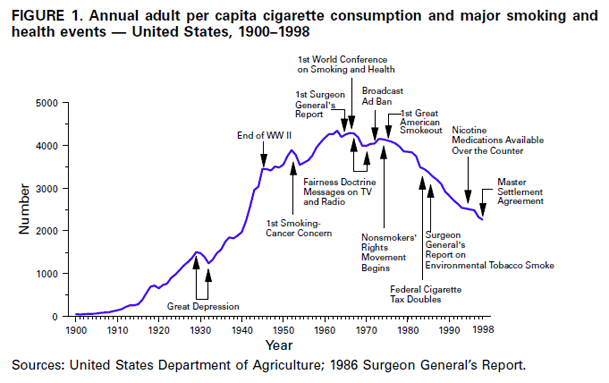
Finally, a primary concern of smoking (though the claim asserted by anti-smoking campaigns is that it increases all forms of cancer), has been lung cancer. This disease takes on average 20-30 years to develop (Howlander et al.), and while cigarette consumption had reached 80% and 90% of its peak by 1945 and 1950, respectively, lung cancer peaked in 1991 and 80% and 90% were reached in 1973 and 1980, respectively. Most importantly there are no spikes and dips as with tobacco use rates and consumption, but lung cancer is a smooth increase and decline, in direct communication with radioactive exposure and pursuant half-lives. Lung cancer mortality has not decreased in kind with decreasing smoking rates however, and in fact only plateaus with the ban of nuclear weapon's testing and nuclear power plant construction. While cigarette smoking has dropped by over half since 1975, lung cancer mortality has gone from 75 to 65 per 100,000, an insignificant change which after adjusting for atmospheric radiation actually indicates that smoking cessation has cost many lives.  See image below for lung cancer mortality in the USA.


A doctor I interviewed on this matter mentioned to me that it was a possibility that infectious diseases were accountable for the increase in cancer mortality, but that they did not know for certain, not having looked these statistics up. I have acquired the infectious disease mortality rate, and it has not changed since anti-smoking campaigns went into effect and in fact increased which means that the potential positive effects of tobacco may be even greater than suggested by simply looking at other raw data, possibly due to lost funding diverted to misguided anti-smoking campaigns. In any case the veracity of the failure of anti-smoking campaigns cannot be questioned in the war on cancer, and is a monumental public policy choice that must be reverted immediately.
Works and Sources Cited:

Centers For Disease Control

Howlader N, Noone AM, Krapcho M, Garshell J, Miller D, Altekruse SF, Kosary CL, Yu M, Ruhl J, Tatalovich Z, Mariotto A, Lewis DR, Chen HS, Feuer EJ, Cronin KA (eds). SEER Cancer Statistics Review, 1975–2011, National Cancer Institute. Bethesda, MD, http://seer.cancer.gov/csr/1975_2011/browse_csr.php?sectionSEL=15&pageSEL=sect_15_table.19.html, based on November 2013 SEER data submission, posted to the SEER Web site, April 2014.

LAFUMA, J., CHMELEVSKY, D., CHAMEAUD, J., MORIN, M., MASSE, R., AND KELLERER, A. M. Lung Carcinomas in Sprague-Dawley Rats after Exposure to Low Doses of y Rays. Radiat. Res. 118, 230-245 (1989).

National Cancer Institute at the National Institutes of Health

Wednesday, October 29, 2014

New research suggests that nicotine creates cellular drills, targeting and perforating smooth muscles over a period of six hours.

Contrary to popular belief, that carbon dioxide level exposure had to be extreme in order to deposit enough tar to permanently damage the lungs, it is now becoming clear that the cause of lung cancer and other smoking related problems is in fact nicotine. It was an old wives' tale or counterargument from smokers that because people living in big cities inhaled half of a pack to a pack of cigarette in smoke from smog each day, but did not have high lung cancer rates like second hand smokers, there must be something wrong with the tobacco studies that were done. Living in a city with hundreds of thousands of cars cars was equivalent to "two packs of cigarettes a day" while any smoker will have a 24-35 in 100 chance of lung cancer (500-1000 times higher than simply being a city dweller). In Bejing today, this rate is 42 in 100,000. People who use candles or incense frequently only have 7 or 8, slightly more than regular marijuana smokers. This perhaps indicated that in fact smoking cessation products cause lung cancer; that it is not smoke, but nicotine that causes the lung cancer has only been proved this last year. Possible explanations at the time included contaminants to tobacco or asbestos, hence natural brands such as American Spirit advertised as such to me as a teenager.
However, in 2013, a new paper delivered at the American Society for Cell Biology managed to watch the molecules of nicotine fold into drills after being present in the blood stream for a continuous six hours. These target smooth muscles, such as those found in the heart, epidermis, lungs, and reproductive system as well as throughout the body. This helps to explain why a secondhand smoker in a house with a heavy smoker has a greater chance of lung cancer than a light smoker. It is conceivable that users of e-cigs or nicotine substitution products such as the patch or gum living in a big city could give themselves lung cancer as well by pollutant exposure as the body becomes unable to naturally clean itself.
Much credit is deserved for Brown professor Ching-Ming Hai, who discovered these cellular drills called podosome rosettes. By establishing the link between heart disease such as atherosclerosis and nicotine, the way has been opened to investigate the role of nicotine on other organs such as the lungs. Being able to observe this phenomenon suggests a veritable hypothesis that other smooth muscles in the body will and do respond in a similar way, eventually tearing and folding under continued nicotine exposure.
Some research has existed which supports this hypothesis that lung cancer is caused by nicotine, including studies which suggest that lung cancer is sped up by nicotine exposure (Dasgupta). For the first time, it can be assuredly said that in fact the cause is in nicotine. This supports the population data. In all of Mexico, for example the lung cancer rate is 5 in 100,000 (Lazcano). Introducing smoke increases this eight times, to as much as and over 40 in 100,000 with smog and air pollution (Wang). With nicotine exposure, this jumps to the 30,000 in 100,000 or thirty percent that indicates lung cancer is caused by tobacco.
This is affirmed by research using populations in Sweden and in California in which smokers of marijuana were not found to have increased cancer rates, or only slight and suggested links to cancer. Research along these lines were released in the 1990s and 2000s, though did not have at this time any scientific rationale for the phenomenon, which can now be attributed to nicotine. Continuing research along these lines should provide alternatives and safe products, once again, to combat use of sweets and bubblegum which were originally the targets of tobacco advertising.


http://articles.chicagotribune.com/2001-07-05/news/0107050231_1_smog-alert-mexico-city-greenhouse-gases
http://www.ncbi.nlm.nih.gov/pubmed/9428585
http://www.ncbi.nlm.nih.gov/pmc/articles/PMC1796573/
http://www.businessweek.com/articles/2014-02-28/rates-of-lung-cancer-rising-steeply-in-smoggy-beijing
http://lungcancer.about.com/od/Lung-Cancer-And-Smoking/f/Smokers-Lung-Cancer.htm
http://www.cnn.com/2013/12/16/health/nicotine-e-cigarettes/
http://www.webmd.com/cancer/news/20060720/nicotine-speeds-lung-cancer
http://link.springer.com/article/10.1007/s10552-013-0259-0
http://link.springer.com/article/10.1023/A:1018427320658

Bibliography:

Dasgupta, Piyali, et al. "Nicotine induces cell proliferation by β-arrestin–mediated activation of Src and Rb–Raf-1 pathways." The Journal of clinical investigation 116.8 (2006): 2208-2217.

Lazcano, Ponce EC, et al. "Trends of lung cancer mortality in Mexico."Archives of medical research 28.4 (1996): 565-570.

Wang, Q. "[An analysis of incidence mortality and survival rates of lung cancer in Beijing]." Zhonghua liu xing bing xue za zhi= Zhonghua liuxingbingxue zazhi12.4 (1991): 205-207.


Addendum: It should be noted that this does not indicate that nicotine or tobacco is responsible for cancer. Since the US cracked down on tobacco use, with success in white males, the overall cancer mortality rate has increased from 184 per 100,000 in 1950-69 to 209 per 100,000 from 1970-1994. Today that rate holds steady at 203 per 100,000. In white females and in other demographics cancer rates have been steady or changed in negligible amounts, but these demographics have had increasing tobacco use rates. Cancer is a painful and unnatural death that can often involve long battles with the disease and should be combated with all resources available, in treatment and in prevention. While lung cancer rates have fallen, technological advances have allowed earlier detection of lung cancer, which at stage 0 and 1 is among the least deadly forms of cancer, but at later stages is among the most deadly. Without adjustments for technological advances in medical care, no positive statement can be made in regards to success or negative results from anti-smoking campaigns. Meta-data from overall cancer mortality does show that the resources in the war on cancer have been squandered and had an overall detrimental effect on the national health of the country, and some policy change is necessitated, although it must be noted there is no current biological explanation for the lower cancer rates in countries and places with higher tobacco use, these have been correlative not causal links. See following for more: http://platophilosphy.blogspot.com/2015/01/increasing-cancer-mortality-rates.html